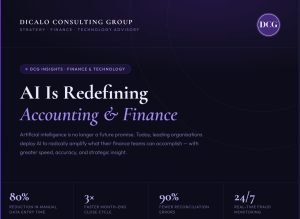
How AI Is Redefining Efficiency in Accounting & Finance

How AI Is Redefining Efficiency in Accounting & Finance
From transaction processing to strategic forecasting — artificial intelligence is no longer a future promise. It is a present-day competitive advantage.
DCG
Dicalo Consulting Group
Strategy · Finance · Technology Advisory
The finance and accounting function has traditionally been defined by volume — large volumes of transactions, reconciliations, reports, and compliance obligations. For decades, managing that volume meant hiring more people and investing in larger teams. AI is fundamentally changing that equation.
Today, leading organisations are deploying AI not to replace their finance teams, but to radically amplify what those teams can accomplish — with greater accuracy, speed, and insight.
Time saved
80% Reduction in manual data entry time through AI-powered automation
Error reduction
up to 90% Fewer reconciliation errors when AI handles transaction matching
Close cycle
3× faster Average month-end close acceleration reported by AI-adopters
Fraud detection
Real-time AI flags anomalous transactions as they occur, not after the fact
- Automated Accounts Payable & Receivable
AI-powered invoice processing tools can extract, classify, and post invoice data directly into ERP systems — without human intervention. Supplier invoices received by email are scanned, validated, matched to purchase orders, and routed for approval automatically.
Real-world example
A mid-sized manufacturing company processing 4,000 invoices monthly reduced its AP team’s processing time by 75% after deploying an AI document processing layer, freeing the team to focus on supplier relationship management and cash flow optimisation.
- Intelligent Bank Reconciliation
Machine learning models trained on historical transaction patterns can auto-match bank entries to ledger records with near-perfect accuracy — even for complex, high-volume accounts. Exceptions are automatically flagged and prioritised for human review, cutting reconciliation cycles from days to hours.
Real-world example
A regional bank subsidiary using AI reconciliation reduced its month-end close from 8 working days to under 3, and virtually eliminated the backlog of unmatched items that had previously required a dedicated team.
- Predictive Cash Flow & Financial Forecasting
Traditional forecasting relies on static spreadsheet models built on historical averages. AI-driven forecasting ingests real-time data — sales pipelines, payment cycles, market signals — and produces dynamic, rolling forecasts with confidence intervals. Finance leaders stop reacting to the past and start anticipating the future.
Real-world example
A retail group with seasonal cash flow volatility deployed an AI forecasting engine that reduced its working capital buffer by 20% while improving liquidity management — directly improving return on capital employed.
- Tax Compliance & Regulatory Reporting
AI tools can continuously monitor transactions against the latest tax rules and flag potential compliance issues before they become liabilities. In jurisdictions with complex VAT, withholding tax, or transfer pricing requirements, this is transformative — reducing both compliance risk and the cost of external advisory.
Real-world example
A multinational operating across seven African markets uses an AI-enabled tax engine that auto-maps transactions to country-specific reporting requirements, reducing manual tax preparation time by 60% and eliminating recurring filing errors.
- Fraud Detection & Internal Controls
AI models can analyse 100% of transactions — not just sampled populations — identifying anomalies, duplicate payments, unusual vendor patterns, and segregation-of-duties violations in real time. This transforms internal audit from a periodic exercise into a continuous monitoring capability.
Real-world example
A financial services firm implemented an AI-driven continuous audit layer that detected a vendor fraud scheme involving duplicate invoicing within 48 hours — a scheme that had gone undetected for months under the previous quarterly audit cycle.
The Strategic Implication
The CFOs and finance leaders gaining the most ground are those who reframe AI not as a cost-cutting tool, but as a capacity-creation tool. When AI absorbs the transactional burden, finance teams are liberated to deliver higher-value analysis, business partnering, and strategic counsel — the work that actually drives growth.
The question is no longer whether AI will reshape accounting and finance. It already is. The question is whether your organisation will lead that transition or react to it.
How Dicalo Consulting Group can help
We work with finance leaders across Central Africa, Middle east, Africa and beyond to design and implement AI-enabled finance operating models — from process diagnostics to technology selection and change management. If your finance function is ready to move beyond spreadsheets and manual processes, let’s have that conversation.
#AIInFinance#FinanceTransformation#CFOInsights#AccountingAutomation#DicaloConsulting#FutureOfFinance