
Five Easy Steps to Launch Your Small Business

Starting a small business is an exciting journey, but it can also feel overwhelming without the right guidance. Many aspiring entrepreneurs have brilliant ideas but struggle with where to begin or how to structure their path to success.
At DCG, we understand that building a successful business requires more than just an idea. It takes careful planning, strategic decision-making, and a clear understanding of your market.
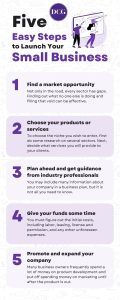
To help aspiring entrepreneurs and business owners, we’ve outlined five practical steps that can guide you from idea to execution.
1. Find a Market Opportunity
Every successful business begins with identifying a gap in the market. Rather than simply creating a product or service you like, focus on solving a real problem that people are already experiencing.
A market opportunity exists when there is demand that is not being fully met. This could be an underserved audience, an inefficient service, or a product that can be significantly improved.
To identify opportunities, ask yourself:
- What problems do people frequently complain about?
- Are there services that customers wish were faster, cheaper, or more convenient?
- Are there industries where innovation is needed?
Conducting basic market research and analyzing competitors will help you better understand where your business can provide real value.
2. Choose Your Products or Services
Once you have identified a promising opportunity, the next step is defining what exactly your business will offer.
Your product or service should directly address the market gap you identified. At this stage, clarity is critical. Avoid trying to offer too many things at once. Instead, focus on a clear niche that allows you to build expertise and credibility.
Consider the following when choosing your offerings:
- What specific problem will your product or service solve?
- Who is your target audience?
- What makes your offering different from competitors?
The clearer your value proposition, the easier it will be to communicate your brand and attract customers.
3. Plan Ahead and Seek Professional Guidance
Many small businesses fail not because the idea is bad, but because planning was inadequate.
Developing a structured business plan helps you organize your vision and identify potential challenges early. A strong plan typically includes:
- Your business objectives
- Market analysis
- Target audience
- Revenue model
- Marketing strategy
- Operational plan
Additionally, seeking advice from industry professionals, consultants, or mentors can help you avoid common mistakes and accelerate your growth.
Professional guidance provides insight into financial planning, legal compliance, operational strategy, and long-term scalability.
4. Give Your Funds Some Time
One of the biggest misconceptions about entrepreneurship is that businesses become profitable immediately. In reality, most businesses require time to stabilize and grow.
Launching a business involves several initial costs, including:
- Licensing and registration
- Operational setup
- Equipment or technology
- Marketing and branding
- Staffing and labor
It is important to have a financial cushion that allows your business time to gain traction. Entrepreneurs should also anticipate unexpected expenses and plan accordingly.
Proper financial planning ensures that your business can survive the early stages while building a strong customer base.
5. Promote and Expand Your Business
Even the best products and services cannot succeed if people are unaware of them. This is why marketing and brand visibility are essential for business growth.
Many entrepreneurs make the mistake of focusing entirely on product development while postponing marketing efforts. However, promoting your business early can help you build awareness and attract your first customers.
Effective promotion strategies include:
- Building a strong online presence
- Leveraging social media platforms
- Creating valuable content
- Running targeted advertising campaigns
- Networking within your industry
As your business grows, marketing efforts should also evolve to support scaling, expansion, and brand positioning.
Final Thoughts
Launching a small business is not just about having a great idea – it’s about executing that idea with strategy and discipline.
By identifying the right opportunity, defining your offering, planning carefully, managing finances wisely, and promoting your brand effectively, entrepreneurs can significantly increase their chances of long-term success.
At DCG, we are committed to helping businesses grow through strategic insights, expert guidance, and practical solutions.
Whether you are starting your first business or looking to expand an existing one, having the right strategy in place can make all the difference.