
Why Most Business Strategies Fail: The Real Reasons and How to Fix Them

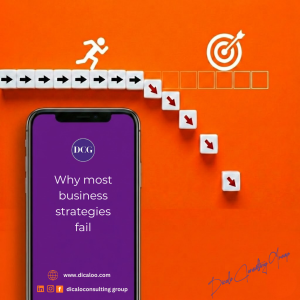
Business strategy is supposed to be the roadmap to growth, profitability, and long-term success. Yet, research consistently shows that over 60–70% of business strategies fail to deliver their intended results.
Why?
Not because leaders are unintelligent or lazy- but because most strategies are poorly designed for execution in the real world.
In this in-depth guide, we break down why most business strategies fail, the common mistakes business owners and executives make, and how to build strategies that actually work, especially for SMEs and growing companies.
What Is a Business Strategy?
A business strategy is a structured plan that outlines how an organisation will achieve its goals, compete in the market, allocate resources, and sustain growth over time.
A strong business strategy should answer:
- Where is the business going?
- How will it get there?
- What resources are required?
- Who is responsible for execution?
- How will success be measured?
Unfortunately, many businesses stop at the planning stage- and that’s where the problems begin.
1. Strategy Is Built on Assumptions, Not Data
One of the biggest reasons business strategies fail is decision-making based on assumptions rather than data.
Common examples include:
- Overestimating market demand
- Assuming customer loyalty without evidence
- Copying competitors’ strategies without context
- Ignoring financial and operational constraints
Without accurate data- financial reports, customer insights, market analysis, and performance metrics – strategies become educated guesses, not informed decisions.
2. No Clear Link Between Strategy and Execution
Many organisations treat strategy as a one-time document, not an operational system.
What usually happens:
- Leadership creates a strategy
- The document is shared (or not shared)
- Teams return to business as usual
When employees don’t understand how strategy connects to:
- Their daily tasks
- Performance expectations
- KPIs and targets
…the strategy dies quietly.
Strategy without execution is just theory.
3. Lack of Accountability and Ownership
A strategy fails quickly when:
- No one owns specific outcomes
- Responsibilities are unclear
- Deadlines are flexible
- Performance is not tracked
Without clear accountability, even the best plans lose momentum.
Successful strategies assign:
- Clear roles
- Measurable objectives
- Timelines
- Review mechanisms
If everyone is responsible, no one is responsible.
4. Poor Financial Alignment
Many strategies look impressive but ignore financial reality.
Common financial misalignments include:
- No realistic budgeting
- Cash flow constraints not considered
- Overambitious growth targets
- No cost-benefit analysis
A strategy that doesn’t align with:
- Cash flow
- Profit margins
- Funding capacity
…is not sustainable.
5. Resistance to Change Inside the Organisation
Even the best strategies fail when people resist them.
Resistance often comes from:
- Fear of job loss or role changes
- Poor communication from leadership
- Lack of involvement in the strategy process
- Weak change management
People don’t resist strategy – they resist uncertainty.
Effective strategy implementation requires:
- Clear communication
- Leadership buy-in
- Training and support
- Change management systems
6. No Monitoring, Review, or Adjustment
Markets change. Customers change. Regulations change.
Yet many businesses stick rigidly to outdated strategies.
A winning strategy is:
- Reviewed regularly
- Adjusted based on performance data
- Flexible enough to respond to change
Without monitoring and evaluation, failure becomes inevitable.
7. Strategy Is Too Complex to Implement
Overcomplicated strategies:
- Confuse teams
- Slow down decision-making
- Kill momentum
If your strategy cannot be explained clearly, it cannot be executed effectively.
The best strategies are:
- Simple
- Practical
- Easy to communicate
- Easy to measure
How to Build a Business Strategy That Works
To avoid failure, businesses should focus on practical, execution-focused strategy design.
A working business strategy should:
- Be grounded in real data
- Align with financial capacity
- Assign clear roles and accountability
- Translate goals into daily actions
- Include performance tracking systems
- Be reviewed and adjusted regularly
At Dicalo Consulting Group (DCG), we help businesses move beyond theory by designing actionable strategies that align people, processes, and performance.
We don’t just help you plan, we help you execute, measure, and scale.
Most business strategies fail because they are treated as paperwork instead of living systems.
If your strategy is not:
- Driving decisions
- Guiding daily operations
- Measured with clear KPIs
- Supported by your people
…it’s already failing.
The difference between successful businesses and struggling ones is not ambition – it’s execution discipline.
Looking to fix a failing strategy or build one that actually works?
DCG supports businesses with strategic planning, execution frameworks, financial alignment, and performance management designed for real-world results.