What Professional Consulting Actually Fixes in a Business

Professional consulting is often misunderstood. Many business owners assume consulting is about advice, motivation, or high-level strategy sessions that sound good but change very little. In reality, effective consulting is far more practical and far less glamorous.
Professional consulting fixes the structural problems that quietly limit growth, drain profitability, and keep businesses dependent on their founders. These problems are rarely obvious at first glance, but they show up in missed targets, constant firefighting, staff confusion, and financial strain.
This article explains what professional consulting actually fixes, why these issues persist in many organisations, and how addressing them changes the trajectory of a business.
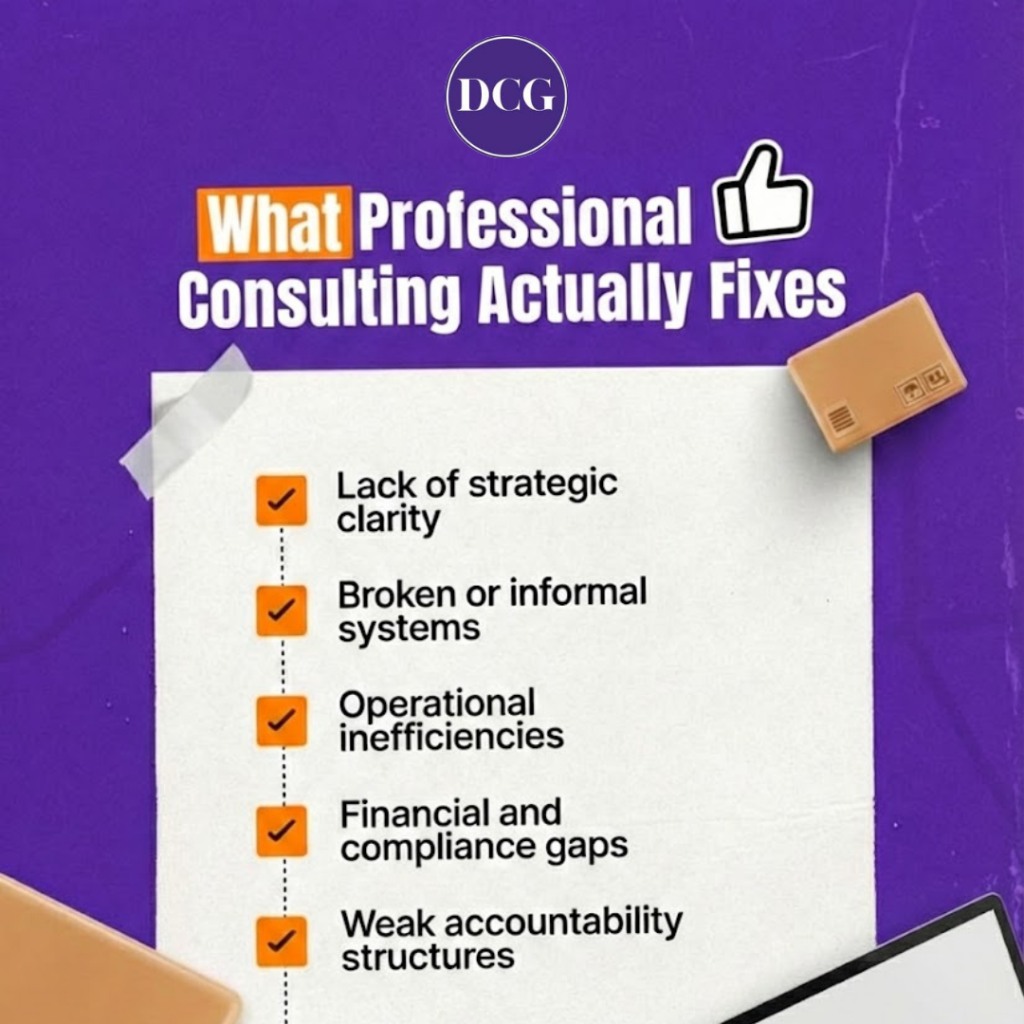
Lack of Strategic Clarity
One of the most common problems in growing businesses is the absence of clear strategic direction. Many leaders are busy every day, yet unable to clearly articulate where the business is going, how it plans to get there, or what should take priority.
This lack of clarity leads to:
- Conflicting decisions across departments
- Short-term thinking driven by urgency instead of impact
- Teams working hard without alignment
- Resources spread too thin across too many initiatives
Professional consulting helps businesses move from vague ambition to clear, actionable strategy. This involves defining realistic goals, identifying the markets and activities that matter most, and translating vision into practical plans that guide daily decisions.
When strategy is clear, leaders stop reacting and start directing. Teams understand what success looks like and how their work contributes to it.
Broken or Informal Systems
Many businesses rely on people instead of systems. Processes exist only in the heads of founders or long-serving staff. Knowledge is not documented. Tasks are repeated inconsistently. When a key employee leaves, performance drops immediately.
Informal systems create:
- Dependency on individuals
- Inconsistent service delivery
- Errors and rework
- Difficulty scaling operations
Professional consulting fixes this by formalising how work is done. This includes documenting processes, defining workflows, standardising tools, and introducing systems that support consistency and accountability.
When systems are in place, the business becomes more predictable, resilient, and scalable. Work continues smoothly even when people change.
Operational Inefficiencies
Operational inefficiency is one of the biggest hidden costs in business. It shows up as duplicated efforts, unnecessary approvals, unclear responsibilities, and wasted time. These inefficiencies are often accepted as normal because they develop gradually.
Over time, they result in:
- High operating costs
- Slow decision-making
- Employee frustration
- Reduced customer satisfaction
Consulting addresses operational inefficiencies by analysing how work flows through the organisation. Bottlenecks are identified. Roles are clarified. Processes are redesigned to reduce friction and improve speed and quality.
The goal is not to make people work harder, but to make the business work better.
Financial and Compliance Gaps
Many businesses focus on revenue while neglecting financial structure and compliance. Records may be incomplete. Cash flow is poorly managed. Regulatory obligations are misunderstood or ignored until they become urgent problems.
Financial and compliance gaps expose businesses to:
- Cash flow crises
- Poor investment decisions
- Tax and regulatory penalties
- Loss of credibility with partners and investors
Professional consulting strengthens the financial backbone of the business. This includes improving financial reporting, budgeting, cash flow management, internal controls, and compliance processes.
When financial visibility improves, leaders make better decisions. Risks are identified early. Growth becomes more sustainable.
Weak Accountability Structures
In many organisations, responsibility is unclear. Tasks are assigned, but outcomes are not owned. When results are missed, blame is shared or avoided altogether. Over time, this weakens performance culture.
Weak accountability leads to:
- Missed deadlines
- Inconsistent execution
- Low ownership among staff
- Leadership burnout
Consulting helps establish clear accountability structures. Roles are defined. Expectations are documented. Performance is measured against agreed outcomes. Review systems are introduced to track progress and address gaps.
Strong accountability does not create pressure. It creates clarity. People perform better when they know what is expected and how success is measured.
Why These Problems Persist
These issues persist because business owners are often too close to their operations to see them clearly. Growth introduces complexity faster than structure. What worked at an early stage becomes a limitation as the business expands.
Professional consultants bring an external, objective perspective. They see patterns leaders may overlook and ask the hard questions that internal teams avoid. More importantly, they help translate insight into action.
What Changes When Consulting Is Done Right
When consulting is effective, businesses experience tangible shifts:
- Decision-making becomes clearer and faster
- Operations become more efficient and predictable
- Financial performance improves with fewer surprises
- Teams become more aligned and accountable
- Founders regain time and control
The business moves from survival mode to structured growth.
Professional consulting does not fix effort. It fixes structure.
It replaces informal practices with systems, assumptions with clarity, and chaos with control. It turns ambition into execution and growth into sustainability.
For businesses that are serious about scaling, consulting is not an expense. It is an investment in building a business that works without constant intervention.
The real value of consulting is not advice.
It is transformation.