Growth Exposes Weak Systems: Signs Your Business Has Outgrown Its Structure

Growth is often celebrated as proof that a business is doing well. Revenue increases, customer numbers rise, and operations expand. But for many businesses, growth also brings confusion, stress, and declining performance.
This is not because growth is a problem.
It is because growth exposes weaknesses that already existed in the business.
When systems are weak, growth does not feel like progress. It feels like pressure.
This article explores the key signs that your business has outgrown its systems, why these issues emerge during growth, and what it takes to build systems that can scale.
Growth Does Not Create Problems. It Reveals Them.
In the early stages of a business, informal processes often work. Decisions are fast, teams are small, and founders are deeply involved in everything. Over time, as the business grows, complexity increases.
More clients.
More staff.
More transactions.
More decisions.
If systems have not evolved alongside this growth, the cracks become impossible to ignore. What once felt manageable starts to feel chaotic. What used to work stops working.
This is the moment when growth exposes weak systems.
Sign 1: Strategic Direction Becomes Unclear
One of the earliest signs that systems are failing is the loss of strategic clarity. Leadership becomes busy responding to daily issues instead of steering the business forward.
You may notice that:
- Priorities constantly shift
- Teams are unclear on what matters most
- Decisions are reactive rather than intentional
- Long-term goals exist but do not guide daily actions
Without clear strategic systems, growth leads to activity without alignment. Effort increases, but impact does not.
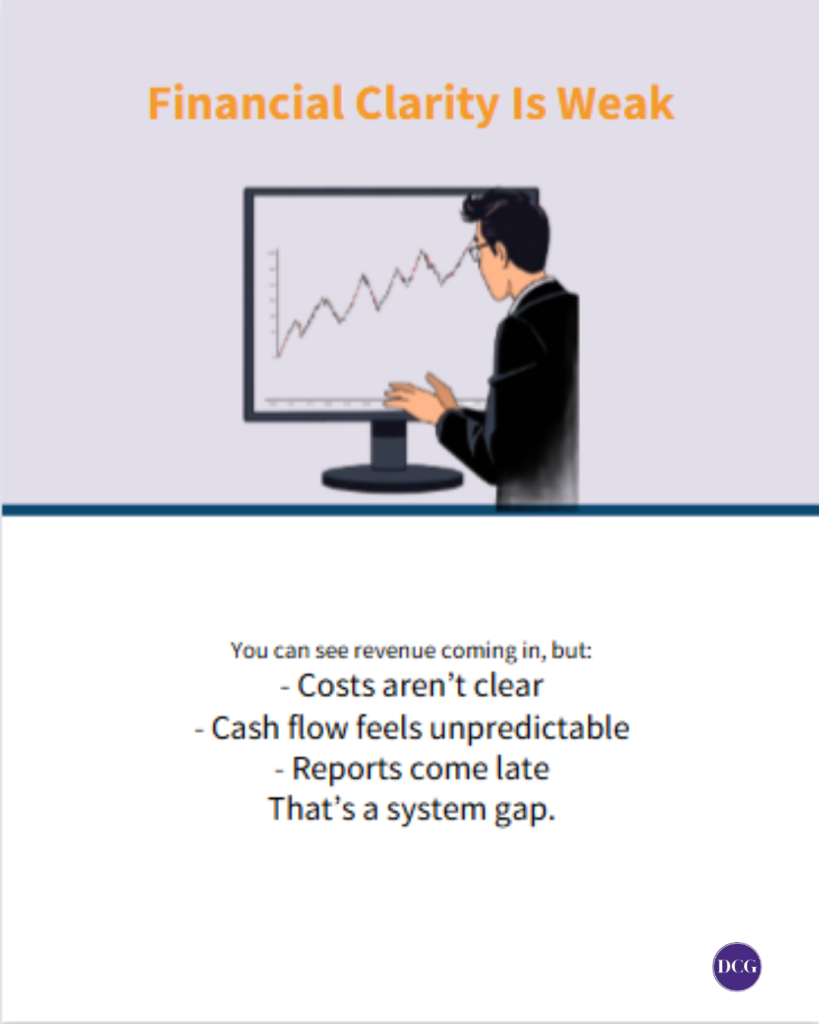
Sign 2: Financial Clarity Is Weak
Financial weakness rarely shows up as an immediate crisis. Instead, it appears as uncertainty.
Revenue is coming in, but:
- Costs are not clearly tracked
- Cash flow feels unpredictable
- Financial reports arrive late or are unreliable
- Leaders cannot confidently forecast or plan
This lack of financial clarity is not a revenue problem. It is a systems problem.
As businesses grow, informal financial management becomes dangerous. Without structured financial systems, leaders are forced to make critical decisions without accurate information.
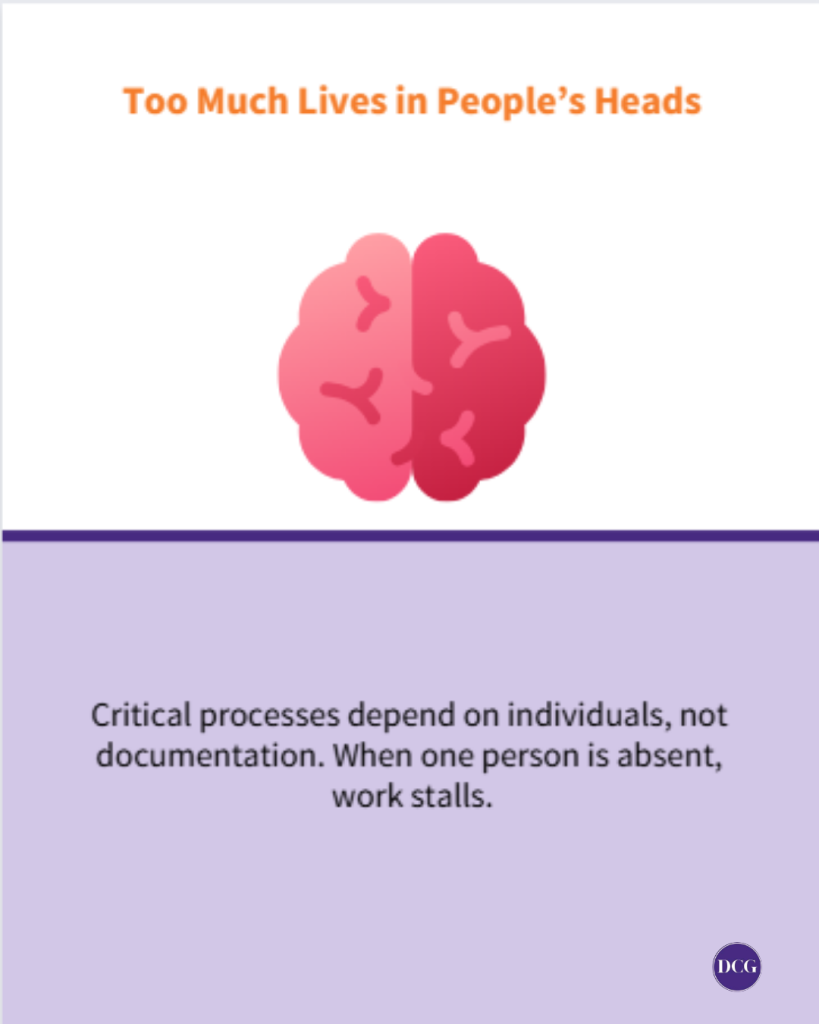
Sign 3: Too Much Knowledge Lives in People’s Heads
When critical processes depend on individuals instead of documentation, growth becomes fragile.
Common warning signs include:
- Work slowing down when certain staff are absent
- Repeated mistakes due to undocumented processes
- New hires taking too long to become productive
- Founders being constantly pulled into routine decisions
Knowledge locked in people’s heads creates dependency and risk. The business becomes vulnerable to turnover, burnout, and inconsistency.
Scalable businesses operate on documented processes, not memory.
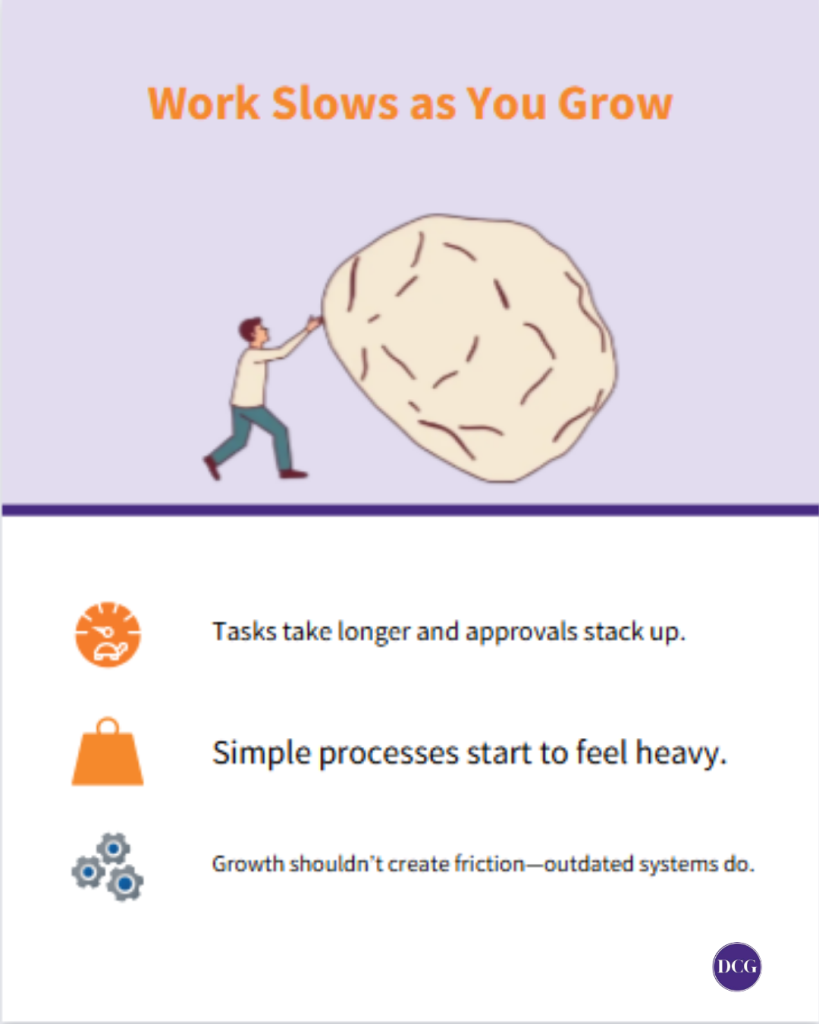
Sign 4: Work Slows as the Business Grows
One of the clearest indicators of weak systems is when growth leads to delays instead of efficiency.
Tasks take longer.
Approvals pile up.
Simple processes feel heavy.
Teams spend more time coordinating than executing.
This happens when systems are not designed to handle increased volume. What worked for a smaller operation becomes a bottleneck at scale.
Growth should increase momentum. When it creates friction, outdated systems are usually the cause.
Why Hustle Is No Longer the Answer
At this stage, many business owners respond by working harder. Longer hours. More pressure on teams. Faster decision-making without structure.
This approach may provide temporary relief, but it is not sustainable.
The next stage of growth does not require more hustle.
It requires better systems.
Structure replaces stress.
Clarity replaces confusion.
Processes replace constant intervention.
What Strong Systems Actually Do
Well-designed systems do not slow businesses down. They enable growth by creating consistency, visibility, and accountability.
Strong systems provide:
- Clear strategic direction that guides decisions
- Financial visibility for planning and risk management
- Documented processes that reduce dependency on individuals
- Efficient workflows that scale with volume
- Accountability structures that support performance
With the right systems in place, growth becomes manageable instead of overwhelming.
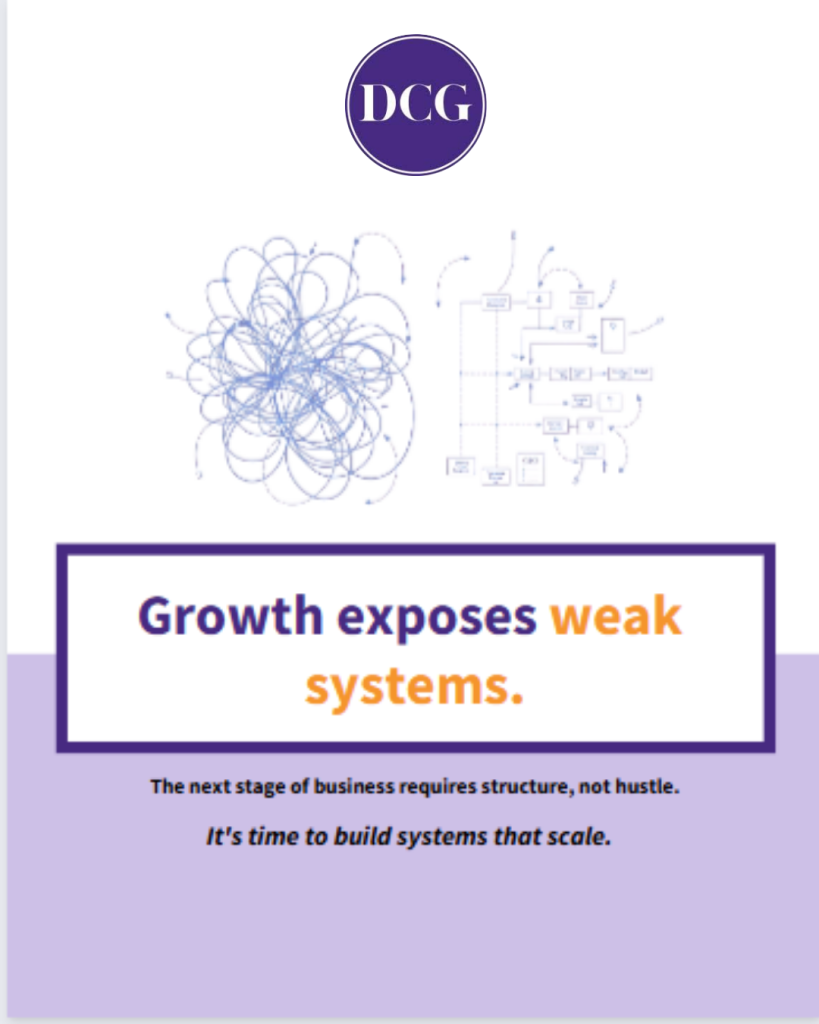
Growth is not the enemy of stability. Weak systems are.
When a business outgrows its structure, the solution is not to push harder. It is to build systems that can support where the business is going, not where it has been.
Businesses that scale successfully understand this early. They invest in structure before chaos forces them to.
Growth will always test a business.
Strong systems determine whether it breaks or evolves.